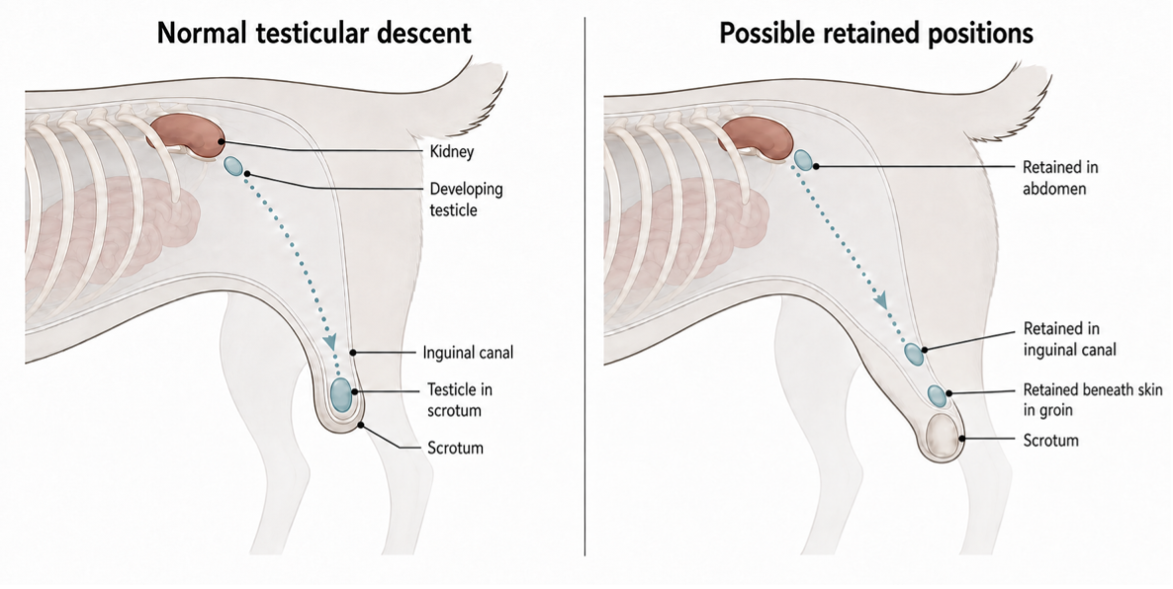
A cryptorchid testicle is a testicle that has not descended normally into the scrotum. It may be located: Beneath the skin in the groin, within the inguinal canal or inside the abdomen
One or both testicles may be affected. A dog with one retained testicle may still be fertile because the normally descended testicle can continue to produce sperm.
What is a cryptorchid testicle?
A cryptorchid testicle is a testicle that has not descendednormally into the scrotum. It may be located:
Beneath the skin in the groin
Within the inguinal canal
Inside the abdomen
One or both testicles may be affected.
A dog with one retained testicle may still be fertile because the normally descended testicle can continue to produce sperm.
Why is castration recommended for cryptorchid dogs?
Cryptorchidism is considered heritable, so affected dogs should not be used for breeding.
Retained testicles also have a substantially increased risk of:
Testicular tumours
Testicular torsion, in which the testicle twistsaround its blood supply
Acute abdominal pain and illness if torsionoccurs
Retained testicles are approximately 9–14 times more likelyto develop testicular tumours than normally descended testicles. Removal ofboth testicles is therefore recommended rather than removing only the retainedtesticle.
How is a retained testicle removed?
The approach depends on its location.
A testicle that can be felt beneath the skin in the groincan usually be removed through a small incision directly over it.
When the testicle is inside the abdomen, the abdomen isgently inflated, and a camera is introduced through a small incision. Theretained testicle is identified using the magnified view, its blood supply issealed and divided, and the testicle is removed.
The laparoscopic procedure generally uses two or threesmall portals. A normally descended testicle is removed through a standardsmall prescrotal incision during the same anaesthetic.
Compared with open abdominal surgery, laparoscopy allowsexcellent visualisation of the abdomen and groin, with less tissue trauma andgenerally a shorter recovery.
Is every dog suitable for keyhole surgery?
Dogs of different ages and sizes may be suitable forlaparoscopic desexing. However, the recommendation is individualised.
Occasionally, an incision must be enlarged or the operationconverted to an open approach. Conversion is a safety decision.
What are the possible risks?
Laparoscopicdesexing is generally well tolerated, and the risk of complications isconsidered low.
Recovery after surgery
Your dog will be monitored until comfortably awake,walking, and able to eat. Most dogs can be discharged on the same day assurgery, depending on their recovery.
At home:
• Keep the incisions clean and dry
• Prevent licking or chewing of the wounds
• Give all prescribed medication as directed
• Avoid running, jumping and vigorous exercise forone week



.svg)
.svg)