Desexing prevents reproduction by removing the organs that produce eggs or sperm and reproductive hormones.For female dogs, we generally perform a laparoscopic ovariectomy, in which both ovaries are removed through small keyhole incisions.
What does desexing in female dogs involve?
Desexing prevents reproduction by removing the organs that produce eggs or sperm and reproductive hormones.
For female dogs, we generally perform a laparoscopic ovariectomy, in which both ovaries are removed through small keyhole incisions.
What is the best age for desexing?
There is no single ideal age for every dog. Some of the reported risks associated with desexing appear to be greater when surgery is performed before puberty, particularly in medium- and large-breed dogs.
Allowing dogs to reach sexual maturity may support normal skeletal development and may reduce the risk of some joint disorders and cancers, although these risks vary between breeds.
Desexing should not necessarily be delayed until older age. In female dogs, advancing age and repeated seasons increase concerns about pyometra and mammary neoplasia. In male dogs, castration before older age may reduce the risk of testicular tumours, perineal hernia and androgen-dependent prostatic disease, particularly benign prostatic hyperplasia.
The best timing should balance the possible risks of very early desexing against the reproductive diseases that become more common later in life.
What is an ovariectomy?
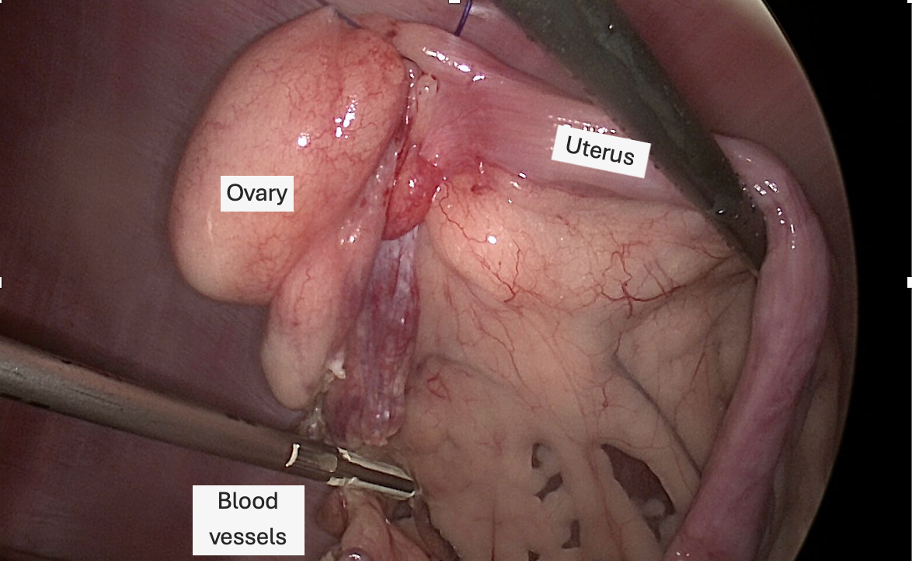
An ovariectomy removes both ovaries while leaving a healthy uterus in place.
The procedure is performed under general anaesthesia. The abdomen is gently inflated with carbon dioxide to create a safe working space. A small camera (1cm) and specialised instruments are introduced through small incisions (0.5cm).
Each ovary is identified using the magnified laparoscopic view. Its blood supply is sealed and divided before the ovary is removed. The surgeon examines both ovaries after removal to confirm that all ovarian tissue has been removed.
Why is removing only the ovaries enough?
The ovaries produce the hormones responsible for heat cycles, fertility, and stimulation of the uterus.
Once both ovaries have been completely removed:
The dog cannot become pregnant
Heat cycles stop
The hormonal stimulation that leads to pyometra is removed
Removing a healthy uterus provides no additional benefit in preventing pregnancy
Leaving a normal uterus in place is not the same as an ovary-sparing procedure. During an ovariectomy, both ovaries and their hormone production are removed.
When Should The Uterus Also Be Removed?
An ovariectomy is intended for dogs with a healthy uterus.
An ovariohysterectomy—removal of the ovaries and uterus—may be recommended when there is:
Pyometra or another uterine infection
Abnormal uterine enlargement or fluid accumulation
A uterine mass or other visible abnormality
Significant damage to the uterus
Mild uterine disease may sometimes be managed laparoscopically, although an additional incision may be required. A large, infected, or fragile uterus may be safer to remove through an open abdominal approach.
Why Choose A Laparoscopic Ovariectomy?
Compared with a traditional open operation, potential advantages include:
Smaller abdominal incisions
Less traction on the ovaries and their supporting tissues
Magnified view of the ovarian blood vessels
Less handling of abdominal tissue
Reduced postoperative discomfort
Faster return to comfortable movement and normal activity
Fewer wound-related problems
A recent study of 519 female dogs found that dogs undergoing laparoscopic ovariectomy had fewer wound complications and a smoother recovery than dogs undergoing traditional open ovariohysterectomy.



.svg)
.svg)